
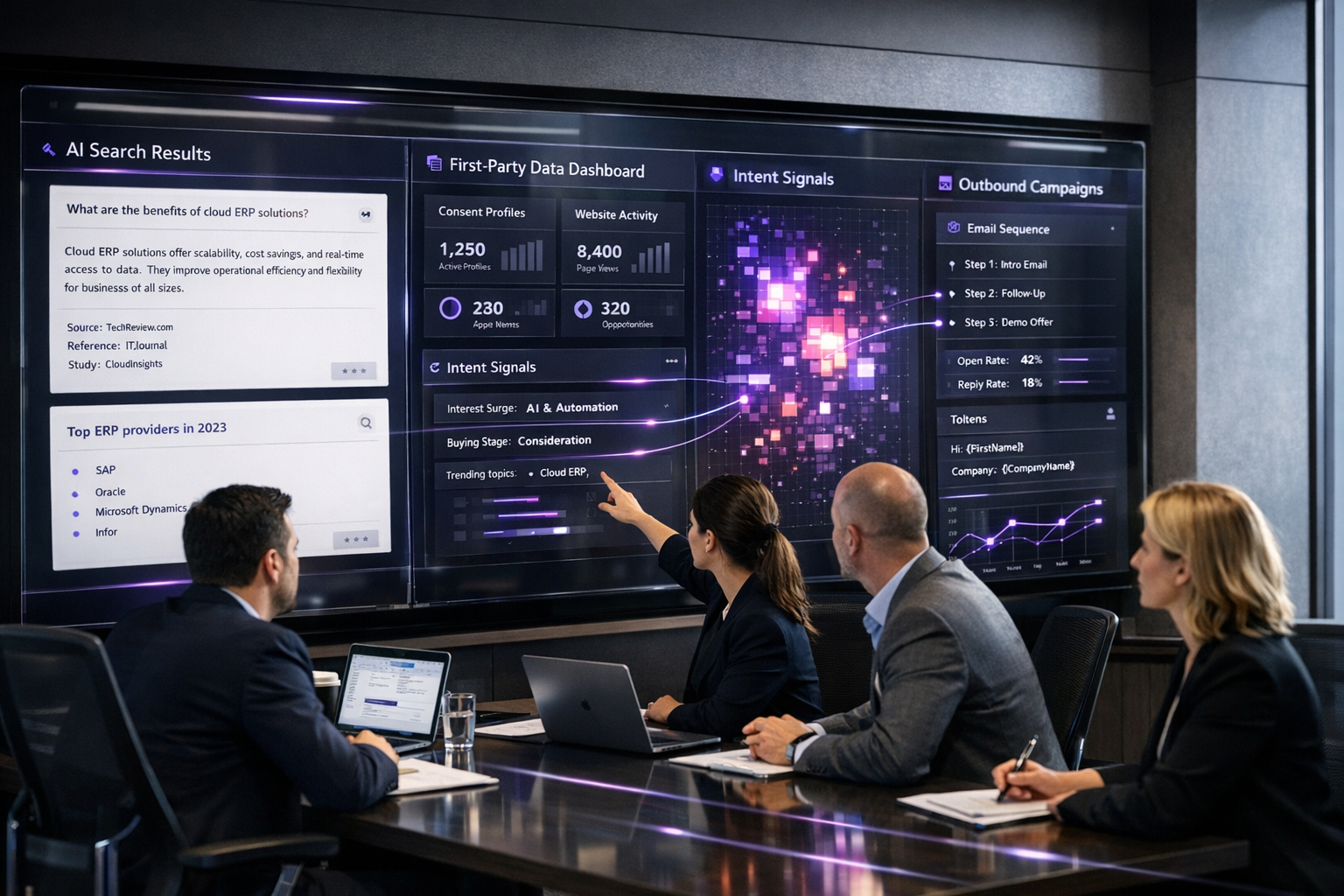
B2B marketing is changing fast. What worked in 2023–2025 (more content, more ads, more emails) is no longer enough. In 2026, the winners will be the teams who build for three shifts happening at the same time:
- Search is becoming AI-led (answers, not clicks)
- Tracking is becoming privacy-first (less cookies, more permission)
- Buying journeys are becoming signal-driven (intent + behavior > assumptions)
At Way2Connect Solutions, we see this every day in outreach performance, lead quality, and pipeline velocity. This blog breaks down the most practical actions you can take right now—so you’re not playing catch-up later.
1) AI Search + Answer Engines: Visibility is moving from “ranking” to “being referenced”
Your buyers are increasingly getting answers from AI-powered search and “answer engines.” Instead of browsing 10 blue links, they ask a question and get a summary. That changes how demand is captured.
This is why b2b marketing trends 2026 ai search and answer engines matters. It’s not a buzzword shift—it’s a distribution shift. Your content needs to be easy to extract, cite, and trust.
What to do now (practical)
- Create “answer-ready” pages: one problem, one audience, one solution.
- Add proof blocks: results, screenshots, mini case stories, FAQs, stats, and clear claims.
- Build internal linking like a map: pillar → cluster → proof → CTA.
- Publish “comparison + decision” content: alternatives, checklists, ROI calculators, implementation guides.
- Use structured content formats: FAQs, how-to steps, bullet lists, tables (where needed), and clear headings.
Way2Connect angle
If your content is only awareness-level, AI summaries may mention you—but not send intent. If your content includes “decision assets,” AI search can act like your top-of-funnel assistant and push buyers closer to a call.
2) First-Party Data: The new fuel for B2B lead generation without cookies
Third-party cookies are fading, and platforms are tightening tracking. That means your best growth lever is what you own: your website behavior, CRM history, email engagement, webinar attendance, and content interactions.
This is where first party data strategy for b2b lead generation without cookies becomes critical. It’s about building a system where every interaction becomes a usable signal.
First-party data you can collect (without being creepy)
- Content downloads (which topics, which persona)
- Webinar registrations + attendance duration
- High-intent page visits (pricing, integration, case studies)
- Email engagement (reply intent, clicks, forwards)
- Demo form fields (role, use case, urgency)
- Product-led signals (trial usage, feature adoption)
- Event booth scans + meeting notes
What to build now (simple system)
- A Lead Source + Intent framework in your CRM
- A clean UTM discipline for campaigns
- A content engagement score (not vanity clicks)
- A central “signals sheet” (even if you’re early-stage)
- Consent-friendly capture points (forms, gated assets, newsletter, webinar)
Way2Connect angle
Way2Connect helps teams turn first-party data into pipeline by designing lead magnets and nurture flows that create trackable actions—not just traffic. The goal isn’t “more leads.” The goal is “more signals per lead.”
3) Intent Signals: Outbound works when you stop guessing and start targeting buying moments
Most outbound fails because it’s sent at the wrong time, to the wrong person, with the wrong message. Intent data fixes timing.
This is the core of how to use intent data and buying signals for outbound campaigns: you don’t pitch randomly. You trigger outreach when a buyer is actively researching, comparing, hiring, expanding, or switching.
Types of buying signals you should use
A) Website signals (first-party)
- Repeated visits to “pricing” or “case studies”
- Viewing integration/security pages
- Multiple visits from the same company domain
- Returning users consuming bottom-funnel content
B) Engagement signals
- Replies (even “not now”)
- Clicking “ROI,” “implementation,” or “pricing” emails
- Webinar attendance + questions asked
- LinkedIn engagement from target accounts
C) Company change signals
- New CXO hire / new Head of Procurement / new IT head
- Funding, expansion, new location, new plant/branch
- Hiring for roles connected to your solution (RevOps, Security, Data, CRM)
D) Market signals
- Competitor comparisons and category search demand spikes
- Industry compliance deadlines
- New regulations or policy changes impacting operations
How Way2Connect turns signals into campaigns
We build “trigger pods”:
- Trigger: a signal (web visit, hiring, funding, compliance)
- Message: specific and contextual (not generic)
- Asset: proof mapped to that trigger (case story, checklist, ROI calc)
- CTA: low-friction next step (audit, benchmark, 15-min fit check)
This is what makes outbound feel relevant and timely.
Putting it together: The 2026-ready B2B marketing stack (without overcomplicating)
You don’t need 20 tools. You need a connected workflow:
- AI-search-ready content that earns trust and gets referenced
- First-party capture points that turn attention into owned signals
- Intent-based outbound that converts signals into meetings
When these three work together, marketing becomes measurable again:
- Better lead quality
- Higher reply rates
- Shorter sales cycles
- Less dependence on paid ads
- More predictable pipeline
How Way2Connect Solutions can help
Way2Connect Solutions helps B2B teams build practical systems for:
- AI-search-friendly content + decision assets
- First-party data capture + nurture workflows
- Intent-driven outbound campaigns (email + LinkedIn)
- Lead scoring and handover playbooks that improve SQL quality
If you want to align your 2026 growth plan with what buyers are actually doing right now, start here: pick one vertical, define your signals, and build one trigger campaign with proof.
That’s how modern B2B growth is being built and Way2Connect is ready to run it with you.
The biggest shifts are AI search/answer engines, first-party data growth, and intent-led outbound based on real buying signals.
Track owned signals like content downloads, webinar engagement, key page visits, and email replies, then score and route leads in your CRM.
Intent signals show timing and interest, so you can personalize outreach, target the right accounts, and book more qualified meetings.